
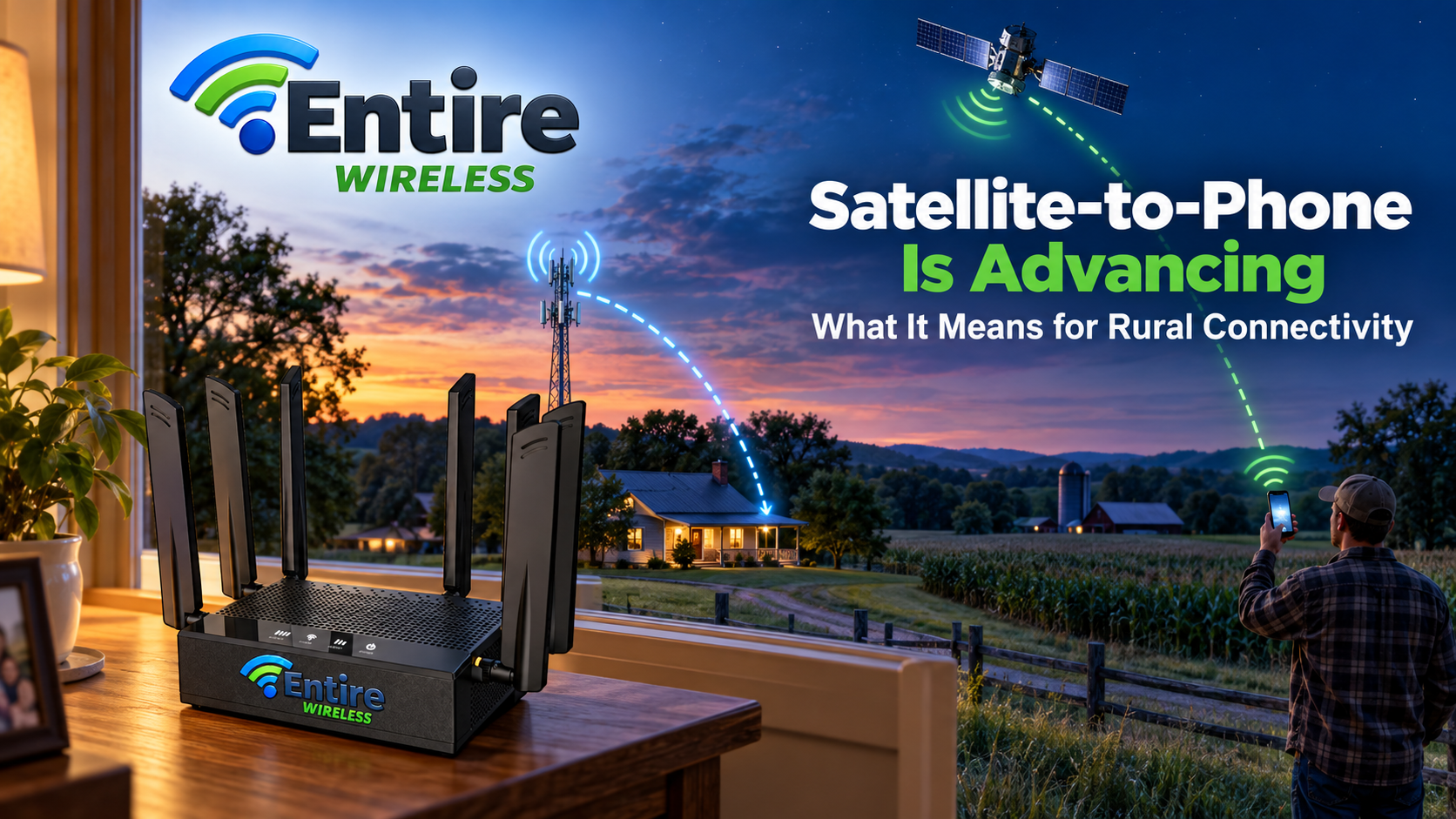
The next phase of rural connectivity may come from combining two powerful technologies: terrestrial wireless networks and satellites orbiting above Earth.
In May 2026, AT&T, T-Mobile, and Verizon announced an agreement in principle to establish a joint venture focused on direct-to-device satellite communications. The proposed collaboration is intended to address wireless coverage gaps, particularly in rural, remote, unserved, and underserved areas of the United States.
The announcement represents an important development for rural connectivity—but satellite-to-phone service and fixed wireless home internet perform different jobs. Understanding that difference helps explain why the future will likely involve several technologies working together.
What Was Announced?
AT&T, T-Mobile, and Verizon plan to combine expertise, limited spectrum resources, and technical standards to make it easier for satellite operators to connect directly with ordinary mobile devices.
According to the companies, the proposed joint venture would work toward:
- Reducing mobile dead zones
- Improving emergency communications
- Expanding satellite-provider competition
- Creating common technical specifications
- Simplifying satellite integration for wireless carriers
- Improving device compatibility
- Helping rural wireless operators introduce new services
The joint venture remains subject to definitive agreements and customary closing conditions. Its potential features, availability, pricing, supported devices, and launch schedule are therefore not final.
The carriers describe satellites as a supplement to the terrestrial networks customers use every day—not as a replacement for those networks. Read the joint announcement from Verizon.
What Is Direct-to-Device Satellite Service?
Direct-to-device technology allows a compatible smartphone or connected device to communicate with a satellite when a conventional cell tower is unavailable.
Traditional satellite communications often require a specialized satellite phone or a separate outdoor terminal. Newer direct-to-device systems are being designed to work with compatible consumer smartphones using spectrum connected to existing mobile networks.
The goal is to extend basic connectivity beyond the reach of terrestrial towers. This can be valuable on rural roads, remote properties, farms, trails, waterways, and during emergencies that interrupt ground-based infrastructure.
What Can Satellite-to-Phone Service Do Today?
Direct-to-device technology is progressing, but it does not yet offer the same experience as a strong terrestrial cellular or fixed broadband connection.
Current satellite-to-phone services may support functions such as:
- Text messaging
- Location sharing
- Emergency communication
- Limited data access
- Selected compatible applications
Capabilities depend on the carrier, device, satellite network, plan, location, outdoor visibility, and network conditions.
For example, T-Mobile currently describes its satellite service as supporting texting and selected satellite-ready applications on compatible devices in many outdoor areas with a visible sky. The company also cautions that speeds are limited, some applications may not function normally, and service can experience gaps or delays. Review T-Mobile’s current satellite-service information.
These limitations are important because “satellite connectivity” does not automatically mean full-speed home broadband delivered directly to a smartphone.
Satellite-to-Phone Is Not the Same as Home Internet
A direct-to-device satellite connection is primarily designed to extend mobile coverage when a terrestrial network is unavailable.
Fixed Wireless Access, or FWA, is designed to provide internet service at a fixed location, such as a home, farm, office, store, or construction site. Compatible equipment receives a wireless connection and distributes internet access to devices throughout the location.
A household may use fixed wireless internet for:
- Streaming television and video
- Remote work
- Online education
- Video conferencing
- Security cameras
- Cloud applications
- Gaming
- Multiple connected devices
- Everyday web browsing
Satellite-to-phone connectivity may help someone send a message from a remote road or reach assistance during an emergency. Fixed wireless broadband is intended to support sustained internet use by an entire household or business.
The two technologies are complementary rather than interchangeable.
Why This News Matters to Rural Communities
People in rural areas frequently travel through places where cellular coverage is weak or unavailable. Direct-to-device satellite technology could provide an additional layer of connectivity in some of these locations.
Potential benefits include:
Fewer Mobile Coverage Gaps
Compatible phones may eventually be able to connect through a satellite when no terrestrial tower is available, reducing the number of places where users have no communication option.
Additional Emergency Resilience
Satellite communications can provide another potential path for messages when a storm, wildfire, flood, power outage, or other emergency damages terrestrial infrastructure.
However, satellite service should not be treated as guaranteed emergency coverage. Availability can still be affected by the device, surroundings, satellite position, network capacity, weather, and view of the sky.
Better Coverage for Rural Travel
Farmers, contractors, delivery drivers, utility crews, outdoor workers, and rural residents may benefit from additional mobile connectivity when traveling between communities or working beyond normal tower coverage.
More Industry Competition
A common technical framework could make it easier for additional satellite companies and rural wireless operators to introduce compatible services. Increased competition may encourage faster development and more customer choices.
Terrestrial Networks Will Remain Essential
Satellites can reach vast areas, but terrestrial wireless infrastructure remains the foundation of everyday broadband and mobile connectivity.
Cell towers and fixed wireless networks generally provide the capacity needed for streaming, video calls, cloud services, online education, business applications, and multiple connected devices.
This is why continued investment in terrestrial networks remains important. Satellite technology can help fill gaps, while fixed wireless networks can provide the primary connection homes and businesses need for everyday use.
The strongest rural connectivity strategy may involve multiple layers:
- Fixed wireless or wired broadband for primary internet access
- Terrestrial cellular networks for mobile communication
- Satellite direct-to-device service for remote-area coverage
- Backup connectivity for emergencies and network disruptions
Together, these technologies can create a more resilient communications system than any single technology operating alone.
What This Means for Entire Wireless
For Entire Wireless, developments in satellite-to-device connectivity reinforce the importance of a technology-flexible approach.
Our current focus remains providing wireless internet service to eligible homes and businesses through available terrestrial network coverage. Entire Wireless does not currently advertise the proposed joint venture’s satellite service as part of its internet plans.
However, we continue to follow developments involving:
- Fixed Wireless Access
- 5G network expansion
- Direct-to-device satellite communications
- Wi-Fi technology
- Network resilience
- Rural broadband deployment
- Connected-home and business equipment
As wireless and satellite systems continue to evolve, Entire Wireless will evaluate technologies that could improve connectivity, reliability, and customer options.
The Future of Rural Connectivity Is a Connected Ecosystem
Satellite-to-phone technology is not expected to eliminate the need for towers, fixed wireless equipment, fiber, cable, or other broadband infrastructure.
Instead, the industry is moving toward an ecosystem in which the most appropriate network can serve each situation.
A family at home may rely on fixed wireless broadband. A driver on a remote highway may temporarily connect through a satellite. A business may use terrestrial service as its primary connection while maintaining a secondary option for emergencies.
That layered approach could help communities stay connected in more places and under more circumstances.
Check Entire Wireless Availability
Entire Wireless provides wireless internet solutions for eligible residential and business locations across the United States. Service availability and performance depend on address eligibility, coverage, equipment, signal conditions, network capacity, and local geography.
Visit natureswireless.org to check availability or call (815) 694-WIRE (9473) to speak with our team.
Entire Wireless — Following the Technology That Connects Communities.