
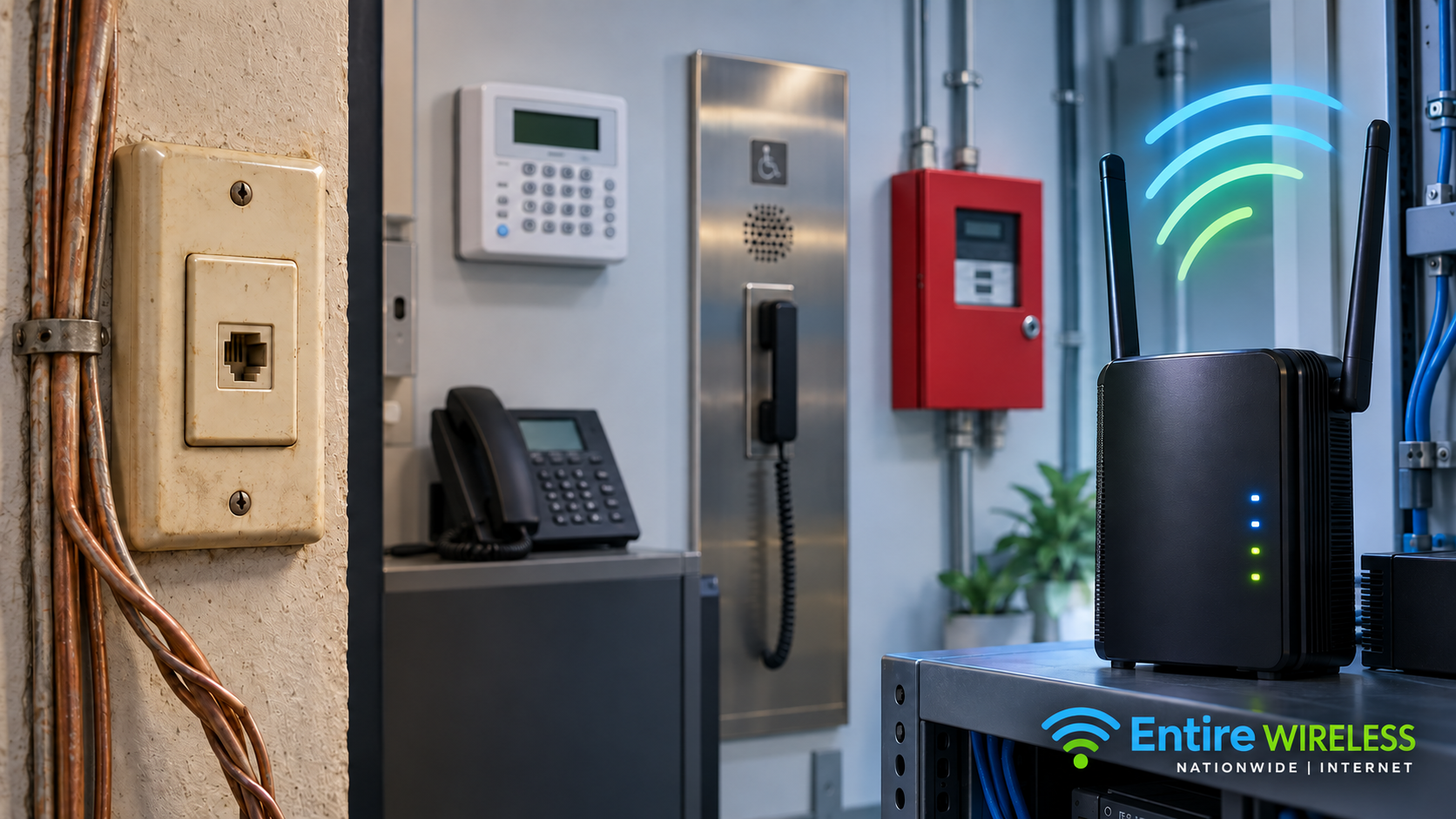
For decades, Plain Old Telephone Service—commonly called POTS—has supported essential business equipment through traditional copper telephone lines. These lines have been used for voice calls, fax machines, alarm panels, elevator phones, fire systems, point-of-sale terminals, gate controls, and other specialized devices.
However, communications providers are steadily modernizing their networks and retiring aging copper infrastructure. As traditional POTS service becomes less widely available, businesses should begin evaluating their connected equipment and planning an orderly transition.
What Is a POTS Line?
POTS is an analog telephone service traditionally delivered over copper wiring. Because the telephone company could supply limited electrical power through the line, many POTS installations continued operating during a local power outage—even when the customer’s building lost electricity.
That dependable, familiar design made copper lines a common choice for important systems such as:
- Security and intrusion alarms
- Fire-alarm communication equipment
- Elevator emergency phones
- Fax machines
- Building entry and gate systems
- Emergency call boxes
- Point-of-sale terminals
- Utility and environmental monitoring equipment
- Traditional business telephone service
Many businesses still have POTS lines installed, even if employees rarely use them to make ordinary telephone calls.
Are All POTS Lines Being Discontinued at Once?
No. There is not one nationwide shutdown date that applies to every customer and every telephone line.
Copper retirement and service discontinuation occur by provider, service area, and location. A business may receive advance notice that its existing service will change, become unavailable, or require migration to another technology.
Even where legacy service remains available, businesses may encounter higher monthly costs, longer repair times, or fewer service options as providers shift their investment toward modern networks.
The important message is simple: businesses should prepare before receiving a final discontinuation notice.
Why Waiting Can Create Problems
Replacing a standard office telephone may be straightforward. Replacing a line connected to an elevator, fire panel, or security system requires more careful planning.
Some devices were designed specifically for analog copper lines. Moving them to another communications platform without checking compatibility can lead to failed calls, reporting problems, inadequate backup power, or difficulty transmitting alarm and monitoring signals.
Waiting until a carrier disconnects service could leave a business rushing to identify every line, coordinate multiple vendors, obtain approvals, and install replacement equipment.
Starting early provides time to make a safer and more informed decision.
Begin With a POTS-Line Inventory
The first step is to identify every traditional telephone line entering the property and determine what is connected to it.
For each line, record:
- The telephone number
- The equipment or system using it
- The equipment manufacturer and model
- The physical location of the device
- The current telephone provider
- The company responsible for maintaining the connected equipment
- Any regulatory, insurance, inspection, or code requirements
- The required battery-backup or emergency-power duration
Businesses with several buildings or locations should complete a separate inventory for each property. It is common to discover active lines that no longer serve a useful purpose as well as critical lines that were missing from internal records.
Modern Wireless Connectivity May Provide an Alternative
Wireless connectivity can be part of a modern replacement strategy for certain POTS applications. Depending on the equipment, location, available network coverage, and applicable requirements, a properly designed wireless solution may carry communications that previously traveled over a copper line.
Potential advantages can include:
- Reduced dependence on aging copper infrastructure
- Faster deployment than installing new wired facilities
- Centralized management across multiple locations
- Flexible placement where wired service is limited
- Options for battery-backed connectivity
- Support for modern network monitoring
A wireless connection is not automatically suitable for every legacy device, however. Equipment compatibility, network signal, emergency calling, backup power, supervision, failover, and local code requirements must all be considered.
Special Attention Is Required for Life-Safety Systems
Fire alarms, elevator phones, emergency call boxes, and security systems should never be migrated without qualified review.
Before making a change, consult the equipment manufacturer, monitoring provider, licensed alarm or elevator contractor, local authority having jurisdiction, insurance provider, and any other responsible professional. The replacement must meet the requirements that apply to the specific equipment and property.
Businesses should also confirm what happens during a commercial power outage. Unlike a traditional copper line, modern communications equipment typically requires power at the customer’s location. A suitable battery or other backup-power system may therefore be essential.
How Entire Wireless Can Help
Entire Wireless helps businesses explore modern wireless connectivity for locations where traditional communications services are changing, expensive, or difficult to obtain.
Our team can help evaluate available wireless coverage and discuss connectivity options for business locations, temporary facilities, remote properties, and other challenging environments.
Because every installation is different, service availability and suitability depend on factors such as location, signal strength, network conditions, connected equipment, power requirements, and applicable regulations. Final compatibility should always be confirmed with the manufacturer and qualified service providers responsible for the connected system.
Prepare Before the Copper Line Disappears
The transition away from POTS service does not need to become an emergency.
By identifying existing lines, documenting connected equipment, consulting the appropriate professionals, and evaluating replacement connectivity early, businesses can build a practical migration plan while they still have time to test it.
If your organization depends on traditional telephone lines, now is the time to find out what they support—and what will replace them.
Contact Entire Wireless to discuss connectivity options for your business or remote location.
Visit natureswireless.org or call (815) 694-WIRE (9473).
Entire Wireless — Connecting Your Business to More.